
Beyond Paper Time Cards: Modernizing Payroll and HR for Equity and Efficiency
- Posted by Team Helios
- On Dec 23, 2025
- 0 Comments
When it comes to advancing student outcomes, the connection between payroll systems and classroom learning might not seem obvious. Yet K–12 school and district leaders know that when operations lag, staff capacity and budgets take the hit. Outdated, paper-based systems drain time, create compliance risks, and make it difficult to see where dollars are actually going.
Jurupa Unified School District recently faced those same challenges and decided to take a different approach. Led by Director of Fiscal Services Jacqueline Benson (Jackie) and Former Payroll Supervisor David, the district reimagined its payroll and HR processes, replacing fragmented systems with a streamlined, digital model. Their experience offers practical lessons any district can use to strengthen efficiency, accountability, and staff morale.
Outgrowing Paper Processes
For years, districts have talked about moving off paper time cards. Still, many rely on them—and Jurupa USD was no exception.
“It’s redundant work,” Benson explained. “Somebody fills out the time card, then someone else has to enter it. That costs time and leaves room for mistakes.”
Paper-based systems also come with hidden costs. Processing each paper time card can take up to 10–15 minutes of staff time, from collection to data entry to verification. Across hundreds or thousands of employees, that adds up to hundreds of staff hours every pay cycle; time that could be spent improving systems, supporting schools, or serving staff directly.
As Jurupa’s team discovered, the costs aren’t just operational—they’re cultural. When errors or delays occur, trust and morale take a hit. “It’s stressful for everyone,” Benson said. “People work hard and expect to be paid correctly and on time.”
By digitizing requests and approvals, districts can reduce manual entry, cut turnaround times, and minimize errors that impact employee paychecks. In Jurupa’s case, shifting to an electronic system led to a measurable difference: fewer late time cards, smoother audits, and more capacity for staff to focus on problem-solving instead of paperwork.
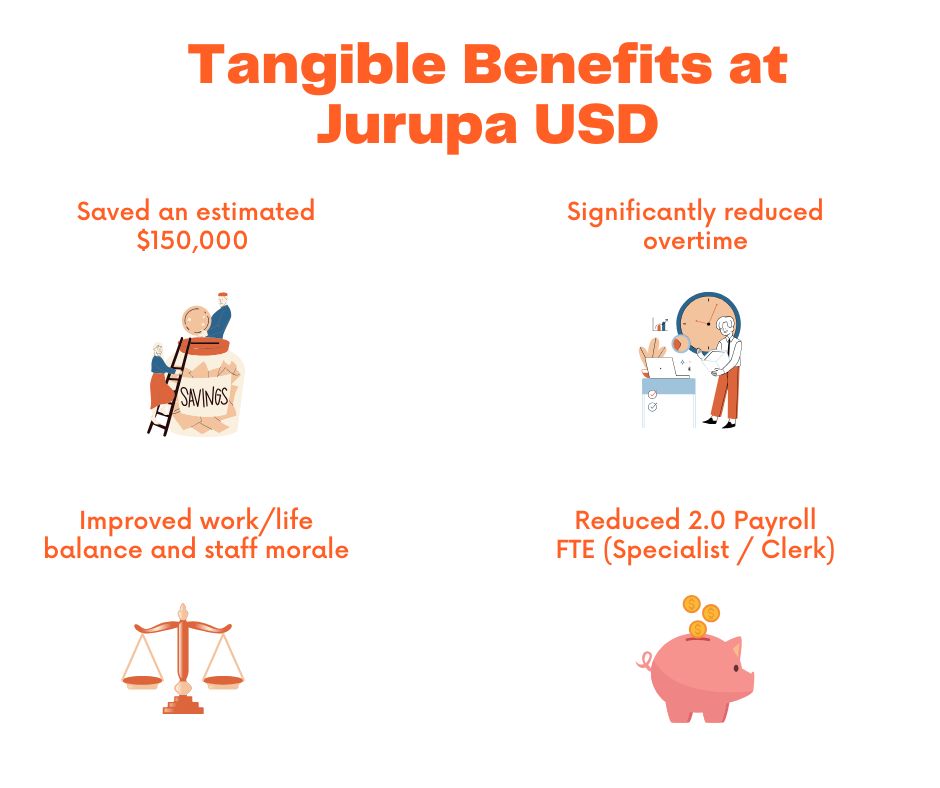
Modern systems make this shift more feasible than ever, allowing leaders to reallocate staff time toward higher-value work that directly supports students and schools. At Jurupa USD, that shift translated into tangible results:
- Reduced two payroll FTEs (specialist and clerk) through efficiency gains
- Created extra capacity to process payroll, improve quality control, and minimize errors
- Significantly reduced overtime while improving overall accuracy
- Saved an estimated $150,000 in cost overruns
- Improved work/life balance and staff morale, turning payroll from a stress point into a source of pride
Every hour saved in the business office becomes an investment back into classroom success.
Real-Time Visibility into Budgets
One of Jurupa’s biggest challenges was managing extra duty and overtime assignments. Requests often bypassed financial systems, leading to significant budget overruns.
“We had sites using extra duty funds without anything encumbered in the system,” Jackie admitted. “The costs added up quickly.”
By moving to a digital workflow, Jurupa was able to encumber funds against site budgets as soon as requests were approved. This transparency not only stopped overspending, but also empowered sites to maximize their Local Control and Accountability Plan (LCAP) dollars without fear of running short.
For leaders, the takeaway is clear: visibility is non-negotiable. When every request is tied to a budget line, districts can steward resources more responsibly and ensure funds support the students they were intended to serve.
Accountability Through Workflows
Strong payroll systems depend on alignment across HR, finance, and school sites. Without clear systems, each department risks working in silos.
Jurupa USD addressed this by implementing customizable workflows that clearly defines every step of a process, from time-off requests to position changes. Each request no routes automatically to the right approvers, and every action is recorded with built in visibility. That clarity eliminates mismatched forms, prevents confusion over who approved what, and ensures HR has the complete picture before payroll processing even begins.
“What used to take weeks to reconcile is now visible in real time,” David shared. “Supervisors see what’s being entered, HR can intervene earlier, and payroll receives cleaner data.”
The result was not only smoother operations, but stronger accountability and trust across departments. With clear approval paths, digital records, and shared access to real-time data, HR, payroll, and finance teams now work from the same source of truth. The result is greater consistency, fewer compliance risks, and stronger collaboration district-wide.
Supporting Staff Well-Being
While much of the conversation focused on systems, Jackie and David were quick to emphasize the human impact.
Payroll is high-stakes, high-pressure work. Mistakes mean late paychecks, tough conversations with employees, and hours of catch-up. By moving to a digital system, Jurupa USD spread workloads more evenly across the month, reduced overtime, and gave payroll staff more time to check their work.
“The stress level has gone down, the accuracy has gone up, and our team has more time to double-check,” Jackie said. “They’re happier, and morale has improved.”
This is a powerful reminder that operational improvements aren’t just back-office wins. They directly affect staff satisfaction, retention, and ultimately the student experience.
Lessons for District Leaders
Jurupa USD’s journey highlights practices other districts can adapt:
- Anchor improvements in real pain points. Identify whether your biggest challenges are paper-based processes, budget blind spots, or audit compliance.
- Balance customization with simplicity. Tailor workflows to your needs but avoid overcomplicating implementation.
- Invest in training and communication. Mandatory sessions for timekeepers and administrators, plus on-demand resources, made Jurupa’s transition smoother.
- Keep the focus on people. Systems should empower staff, not overwhelm them.
When systems save time, reduce costs, and strengthen staff morale, leaders gain the capacity to make strategic decisions that improve operations and advance student success.
Modernizing payroll and HR systems may not sound as urgent as curriculum or instruction, but its impact on student outcomes is real. When districts can cut down on redundant work, gain visibility into budgets, and reduce stress for staff, they create the conditions for stronger teaching and learning.
This content is derived from a March 2024 Lunch & Learn hosted by Helios Ed. Follow Helios Ed on LinkedIn for more conversations like this.
0 Comments