
AI in K-12 Education: Key Insights, Opportunities, and Lessons
- Posted by Team Helios
- On Oct 12, 2026
- 0 Comments
How is AI reshaping the work you do in a meainingful way? Where do you see the greatest opportunity for AI to create operational efficiencies?
Those questions were at the heart of a recent webinar co-hosted by Helios Ed and the American Association of School Personnel Administrators (AASPA) titled “AI in K-12 Education: Transforming Operations, Supporting Employees and Managing Risk” (2026). In this webinar, a panel of education leaders from Human Resources, Business Services, Technology, and Education Law explored practical, real-world applications of AI across school district operations.
The discussion highlighted how AI-powered solutions can provide employees with faster answers to HR, payroll, benefits, and policy questions, reducing routine calls and emails while allowing HR teams to focus on employee support and organizational success. Panelists also explored the critical foundations for responsible AI adoption, including governance, data privacy, compliance, workforce readiness, and change management. Whether a district is just beginning its AI journey or looking to expand existing initiatives, the conversation offered actionable insights and best practices for implementing AI thoughtfully, effectively, and responsibly.
Read on to explore the key takeaways and practical recommendations from the webinar to help K–12 leaders adopt AI responsibly, streamline district operations, and keep employees and people at the heart of every decision.
The numbers tell an important story
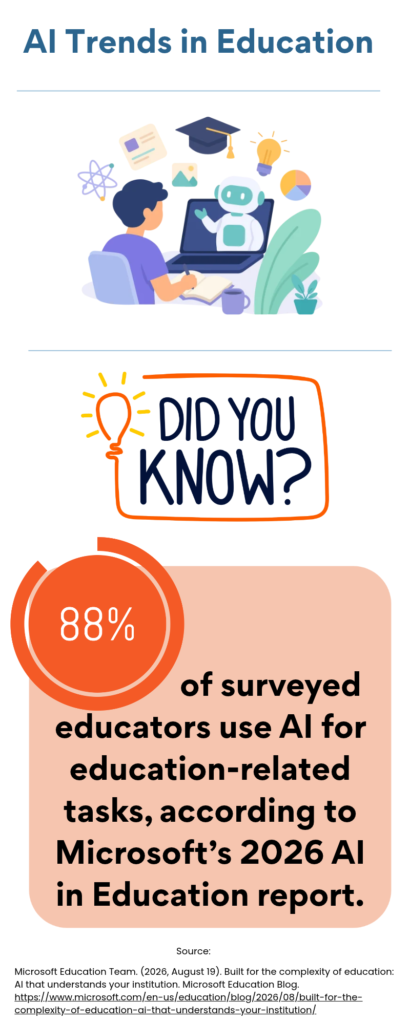
According to Gallup’s 2025 workplace research, 40% of U.S. employees reported using AI in their role at least a few times a year, an increase from 21% in 2023 (Gallup, 2025). The takeaway for K–12 leaders isn’t that every employee is already using AI. It’s that AI adoption is moving quickly enough that it greatly benefits to have a strategy.
While much of the conversation around AI in education focuses on classroom instruction and student learning, its potential extends well beyond the classroom. For HR departments, business offices, technology teams, and legal professionals, AI can help reduce administrative burdens, improve responsiveness, and create more time for the work that matters most. With that said, these benefits require more than adopting a new technology. It calls for thoughtful planning, clear governance, ongoing training, and a commitment to responsible use.
Why AI Matters in K–12 Operations
School districts are being asked to do more with limited time, staffing, and budgets. HR teams manage onboarding, employee relations, benefits, leaves, and credentialing. Business offices oversee payroll, procurement, budgets, and compliance reporting. Technology teams balance cybersecurity, infrastructure, and day-to-day user support. These responsibilities are essential to keeping schools running, but many involve repetitive administrative tasks that consume valuable staff time.
AI can help districts reduce that burden by automating routine processes, organizing information, and making answers easier to find. When implemented thoughtfully, these tools allow employees to spend less time on repetitive work and more time on responsibilities that require professional judgment, specialized knowledge, and personal interaction.
The goal isn’t to replace the people who make school systems work. It’s to give them more time and better tools to do their jobs effectively. This principle extends to the classroom, too. AI can help educators save time, improve efficiency, and create more opportunities for meaningful student engagement. Across both instructional and operational settings, the greatest value comes when AI enhances human capabilities rather than replacing them.
How AI Can Support K–12 HR Teams
HR departments are often the first point of contact for employees with questions about benefits, leave balances, payroll, credentialing, evaluations, and district policies. Answering these questions accurately and consistently is important, but responding to a high volume of routine requests can quickly overwhelm an already busy team.
AI offers several practical ways to help.
1.) Improve Employee Self-Service
AI-powered self-service tools can help employees find answers to common questions without having to wait for an HR representative.
For example, employees might use an approved system to ask:
- How much vacation or paid time off do I have remaining?
- Where can I find information about my benefits?
- What steps do I need to complete for onboarding?
- What is the process for requesting leave?
- Where can I find the district’s employee handbook or relevant policy?
Depending on how the system is configured, AI can direct employees to appropriate resources, summarize approved policy information, or connect them with the correct department.
For questions involving individual employee records, such as leave balances or payroll details, the system must be securely integrated with authorized data sources and verify the employee’s access rights. A general-purpose AI tool should not be given unrestricted access to confidential HR information.
The potential benefit is straightforward: employees can find routine information more quickly, while HR staff have more time to address complex questions and provide individualized support.
2.) Reduce Time Spent Drafting Responses
HR professionals spend considerable time writing and refining emails, explaining policies, preparing employee communications, and responding to recurring questions. AI tools can help draft responses, summarize lengthy documents, organize information, and adapt communications for different audiences.
For example, an HR team could use an approved AI tool to create a first draft of an open enrollment reminder, summarize changes to a benefits guide, or develop a response to a frequently asked question. Rather than starting from scratch, staff can review and refine an initial draft, verify its accuracy, and ensure the tone reflects district expectations.
AI should be a starting point, not the final authority. HR professionals should continue to review communications for accuracy, policy alignment, and sensitivity before sharing them with employees.
3.) Make Policies and Information Easy to Navigate
District policies, procedures, employee handbooks, and benefits documents can be lengthy and difficult to navigate. AI tools may help staff locate relevant sections, summarize key requirements, and identify the documents that address a particular question.
However, AI-generated summaries should not replace official policy documents or professional interpretation. District teams need processes for checking answers against current, authoritative sources, particularly when a question involves employment rights, leave eligibility, or other consequential matters.
The Benefits Extend Beyond Human Resources
Although HR is a natural starting point, AI can support a range of district operations.
- Business Services: Organize financial information, summarize reports, draft communications, and support documentation for procurement and budget processes.
- Technology Teams: Assist with internal knowledge bases, routine support requests, documentation, and troubleshooting workflows.
- Legal and Compliance Teams: Help summarize lengthy documents, organize information for review, and prepare initial drafts for professional evaluation.
- District Leadership: Support the preparation of reports, meeting summaries, communications, and other materials that help leaders make informed decisions.
The greatest opportunity may be reducing the time employees spend on repetitive, information-heavy tasks. That doesn’t mean every task should be automated. Processes involving sensitive employee matters, legal interpretation, financial approvals, or consequential decisions may require additional controls and direct human involvement.
The most effective starting point is to identify tasks that are repetitive, time-consuming, and appropriate for AI assistance, then evaluate whether a tool can perform them reliably and securely.
Legal Considerations and Implementation
One of the strongest recommendations for K–12 leaders is to get ahead of AI governance and policy as soon as possible. AI is evolving quickly, and employees may already be experimenting with tools independently. Without clear expectations, districts risk inconsistent practices, accidental exposure of sensitive information, and uncertainty about who is accountable for AI-assisted work.
Rather than waiting until a problem arises, districts should establish policies and guardrails early, before expanding AI use across departments.
A practical AI governance framework should address:
- Approved tools and acceptable uses: Which AI platforms may employees use, and for what purposes?
- Data privacy and security: What information can be entered into AI systems, and what information must remain in protected environments?
- Access controls: How will districts ensure that users can access only the information they are authorized to see?
- Human oversight: Which tasks require review, approval, or final decisions by a qualified employee?
- Accountability: Who is responsible for monitoring AI use, evaluating results, and responding to concerns?
- Ongoing review: How will policies evolve as technology, regulations, and district needs change?
Governance should not be treated as a document that is written once and filed away. It should be an ongoing process that adapts as districts learn more about the technology and how employees use it.
Importantly, governance is not just an IT responsibility. HR, Business Services, legal counsel, technology leaders, and district administrators each bring a different perspective to the conversation. A cross-functional approach helps ensure that policies reflect operational realities as well as legal, ethical, and security requirements.
The takeaway: Establish clear expectations before implementation, not after.
Start With the Problem, Not the Technology
Another important recommendation is to be intentional about where AI adoption begins. It can be tempting to explore a new tool simply because it is available or generating interest. A more effective approach is to start with a clearly defined problem. You can start by asking:
What process is taking too much time? Where are employees experiencing unnecessary delays? Which routine tasks are preventing staff from focusing on higher-value work?
For HR, that might mean reducing the volume of repetitive employee questions. For business leaders, it could mean simplifying report preparation. For technology teams, it might involve improving access to internal support documentation. Once the problem is identified, district leaders can determine whether AI is an appropriate solution or whether a simpler process improvement would be more effective.
The goal is not to introduce AI everywhere. It is to use the technology where it can make a measurable difference. Just as importantly, districts should avoid removing humans from the loop simply to maximize automation. AI can generate recommendations, summarize information, and assist with routine tasks, but people should retain meaningful oversight- especially when decisions affect employees, finances, legal compliance, or student outcomes.
A thoughtful pilot can help a district test a specific use case, assess accuracy, identify risks, and gather feedback before committing to a broader rollout.
Protecting Student and Employee Privacy
Privacy is a critical consideration in K–12 AI adoption. School districts operate within a framework of state and federal requirements governing the confidentiality and use of student information. Depending on the data and circumstances, laws such as the Family Educational Rights and Privacy Act (FERPA) may apply.
Employee information deserves the same careful attention. HR records can include compensation details, leave and accommodation information, disciplinary history, performance evaluations, and other sensitive employment information. With sensitive or private information, it is imperative to ensure this data is protected.
Before using AI with sensitive information, a few questions districts should ask:
- Is the tool approved for this type of data?
- Does the district have an appropriate agreement with the vendor?
- What assurances exist regarding data storage, processing, retention, and deletion?
- Are access controls and security measures sufficient?
- Does the proposed use comply with applicable laws, contracts, and district policies?
Districts should also understand whether prompts and uploaded documents may be retained or used to train models, what happens when information is deleted, and whether third parties may process the data. A vendor’s description of a product as private or enterprise-ready is not a substitute for reviewing its actual safeguards and contractual terms.
A practical approach is to establish clear rules about which types of information employees may enter into approved AI tools and which must remain in protected systems. Training can help to reinforce those expectations and help staff recognize when they need to consult the district’s technology, privacy, or legal teams.
AI and Legal Considerations: Human Judgement Matters
Using AI does not remove an employer’s responsibility for the decisions it makes. As K–12 leaders evaluate these tools, they should pay particular attention to systems that screen applicants, rank candidates, evaluate employee performance, or otherwise influence employment opportunities. AI may assist with administrative work or help organize information for review, but it should not become an unquestioned decisionmaker in matters affecting someone’s employment.
Before using AI in a consequential employment process, districts should consider:
- Whether the tool has been evaluated for potential bias and adverse impacts.
- Whether its recommendations can be explained and meaningfully reviewed.
- Whether the process complies with applicable federal, state, and local requirements.
- Whether a qualified human decision-maker retains meaningful oversight.
AI adoption should involve the same level of care and governance that districts apply to other technologies handling sensitive information.
Training and Collaboration
Even the most thoughtfully selected AI tool will have limited impact if employees do not know how to use it effectively and responsibly. Training is an essential part of successful implementation. It helps staff understand what AI can and cannot do, recognize inaccurate or misleading outputs, protect confidential information, and apply the technology appropriately to their roles.
For K–12 districts, professional development should extend beyond a one-time introduction to a new tool. As technology and district policies evolve, employees need opportunities to refresh their knowledge, ask questions, share experiences, and learn from real-world examples.
Effective AI training can include:
- Practical, role-specific examples: Show HR, finance, technology, and administrative staff how AI can support tasks they perform regularly.
- Responsible use guidelines: Explain which tools are approved, what information may be shared, and when human review is required.
- Critical evaluation skills: Teach employees to verify facts, check sources, and identify potential bias or errors in AI-generated content.
- Privacy and security awareness: Reinforce how to handle student, employee, financial, and other confidential information.
- Ongoing feedback and support: Create opportunities for employees to report concerns, share successful use cases, and recommend improvements.
Training also helps address a common challenge with emerging technology: employees may either overestimate what AI can do or avoid it altogether because they are unsure how to use it. The objective is to build confidence without encouraging blind trust. When employees understand both the opportunities and limitations of AI, districts are better positioned to realize its benefits while minimizing risk.
Learn From Other Districts
K–12 districts do not have to navigate AI adoption alone. One valuable recommendation is to look at what other districts have already tried, learn from their experiences, and share lessons across the education community. Peer collaboration can help leaders understand which use cases have delivered meaningful results, what implementation challenges have emerged, and which governance practices have proved useful. For example, Bellflower Unified School District has launched an AI design team. Their goal is to collaborate with educators across the district to develop a framework that supports and enhances teaching and learning through the effective use of AI tools.
Consider connecting with neighboring districts, participating in education leadership networks, attending professional conferences, or creating opportunities for HR, Business Services, and technology teams to exchange ideas.
Questions worth exploring with peers include:
- Which AI use cases have saved staff time or improved service?
- What policies and approval processes are in place?
- How are districts addressing privacy, security, and vendor agreements?
- What training has helped employees adopt AI responsibly?
- What challenges or unexpected outcomes have emerged?
- How are districts measuring success?
Sharing lessons learned can help districts avoid repeating mistakes, make more informed purchasing decisions, and identify approaches that are appropriate for their own needs.
Of course, a solution that works for one district may not be suitable for another. Districts differ in size, staffing, technology environments, contracts, and legal requirements. Peer experiences should inform local decision-making, not replace it. Still, collaboration can accelerate learning and help school systems develop more practical, sustainable approaches to AI.
Looking Ahead: More Time for the Work That Matters
AI presents K–12 districts with an opportunity to rethink how administrative work gets done.
For HR teams, that may mean answering routine questions more efficiently and spending more time supporting employees through complex situations. For business offices, it may mean simplifying documentation and reporting. For technology teams, it may mean improving access to support resources. For legal and leadership teams, it may mean spending less time on initial document preparation and more time on analysis and decision-making.
These improvements matter because school operations are ultimately about supporting the people who make education possible. There is also a broader opportunity. As students prepare to enter a workforce increasingly shaped by AI, districts have a responsibility to develop thoughtful, responsible approaches to the technology across their organizations. The way school systems adopt AI can help establish a culture that values innovation while respecting privacy, fairness, accountability, and human expertise.
The path forward is not to automate everything or avoid AI altogether. It is to identify where the technology can help, understand where it creates risk, and put the right safeguards in place.
Key Takeaways for K–12 Leaders
As districts consider their next steps, five principles can help guide a responsible approach to AI.
1.) AI Enhances, Not Replaces, People. AI can help educators save time, improve efficiency, and create more opportunities for meaningful student engagement. In HR and business operations, it can reduce repetitive work and free staff to focus on complex challenges, employee relationships, and decisions that require human expertise.
2.) Governance Must Come Before Implementation. Clear policies, security controls, and accountability are essential to ensure AI is used responsibly, securely, and ethically. Establish expectations early and revisit them as technology and district needs evolve.
3.) Start With a Specific Problem. Identify a genuine operational challenge before selecting a tool. Begin with manageable, lower-risk use cases, measure results, and keep people involved in reviewing outputs and making consequential decisions.
4.) Training Drives Successful Adoption. Ongoing professional development helps staff use AI confidently, recognize its limitations, protect sensitive information, and maximize its benefits while minimizing risks.
5.) Learn and Improve Together. Connect with other districts, exchange experiences, and learn from successful implementations and challenges. Collaboration can help school systems make better-informed decisions and avoid common pitfalls.
Ultimately, AI is not a replacement for the expertise, relationships, and judgment that keep school districts running. It is a potential tool for helping those teams work more efficiently and focus on higher-value responsibilities. By establishing governance early, starting with meaningful problems, investing in staff training, and learning from peers, K–12 leaders can turn AI’s potential into responsible, measurable improvements in district operations.
The ultimate goal is simple: give school employees more time to focus on the people, decisions, and work that matter most.
Curious to see how much AI has changed in just one year? Take a look at our previous blog here. You can also check out other recent webinars from Helios Ed on AI and other hot topics here.
Sources
Buttery, K., et al. (2026, September 8). AI in K-12 Education: Transforming Operations, Supporting Employees and Managing Risk [Webinar]. American Association of School Personnel Administrators & Helios Ed. https://www.aaspa.org/events/ai-in-k-12-education-transforming-operations-supporting-employees-and-managing-risk
Gallup. (2025). AI use at work has nearly doubled in two years. Gallup Workplace. https://www.gallup.com/workplace/691643/work-nearly-doubled-two-years.aspx
Microsoft Education Team. (2026, August 19). Built for the complexity of education: AI that understands your institution. Microsoft Education Blog. https://www.microsoft.com/en-us/education/blog/2026/08/built-for-the-complexity-of-education-ai-that-understands-your-institution/
0 Comments