
Clockwise Thinking: Mastering OBBBA Overtime Reporting
- Posted by Team Helios
- On Jul 30, 2026
- 0 Comments
Clockwise Thinking: Mastering OBBBA Overtime Reporting
How are you currently compiling your OBBBA overtime reports?
If that question gives you pause, you’re not alone. The One Big Beautiful Bill Act (OBBBA) introduced new overtime reporting requirements that are causing payroll professionals, especially those in K–12 education, to rethink how they track, calculate, and report overtime.
The good news? With the right processes and reporting tools, compliance doesn’t have to become another manual burden.
What Is OBBBA?
On July 4, 2025, President Trump signed the One Big Beautiful Bill Act (OBBBA), into law.
One of the law’s key provisions is the “No Tax on Overtime” deduction, which allows eligible employees to receive a federal tax benefit on qualified overtime compensation when they file their annual tax returns (Fisher Phillips, 2026).
It’s important to understand what this does—and doesn’t—mean.
Payroll processing remains the same throughout the year. Employees continue to receive overtime in their regular paychecks, and payroll taxes are withheld as usual. The tax benefit occurs later, when employees file their taxes.
What has changed is the employer’s responsibility. Payroll departments must now accurately identify, track, and report qualified overtime compensation on IRS and Social Security Administration (SSA) reporting forms.
For school districts, that means additional attention to payroll processing, reporting, employee communication, and compliance.
What Counts as Qualified Overtime?
Under OBBBA regulations, qualified overtime compensation refers only to the additional half-time premium required by the Fair Labor Standards Act (FLSA).
Under the FLSA, overtime is generally paid at 1.5 times an employee’s regular hourly rate for all hours worked over 40 hours in a single workweek.
The key word is premium.
Only the additional half-time portion qualifies for OBBBA reporting—not the employee’s regular hourly wages.
Because of this distinction, school districts must carefully separate the qualifying overtime premium from regular earnings and any compensatory time or other payments that fall outside FLSA requirements.
What K–12 Districts Need to Track
Accurate reporting begins with properly categorizing employee pay. Districts should clearly distinguish between three different types of earnings:
- Regular Wages
These are the employee’s standard earnings for regularly scheduled hours worked.
- Straight-Time Overtime Wages
These are overtime hours that are compensated at the employee’s normal hourly rate before applying any overtime premium.
- FLSA Overtime Premium
This is the additional half-time premium required under federal law once an employee exceeds 40 hours worked in a workweek. This is the portion that must be identified for OBBBA reporting.
Separating these categories isn’t simply a payroll best practice—it’s essential for compliance, accurate reporting, and avoiding costly errors.
Understanding Federal vs. California Overtime Rules
For California school districts, overtime reporting becomes more complex because California’s overtime rules differ from federal FLSA requirements.
Since the rules don’t always align, districts can’t rely on a single overtime calculation.
A common workflow includes:
- Identifying employees subject to California overtime rules.
- Calculating overtime under federal FLSA guidelines.
- Determining federal overtime using scheduled workdays, leave taken, and extra duty hours worked.
- Comparing both calculations to ensure compliance with both state and federal requirements.
While this process can be challenging when performed manually, payroll systems like Helios simplify the work by automatically incorporating work schedules, leave, and extra duty assignments into OBBBA-ready reports.
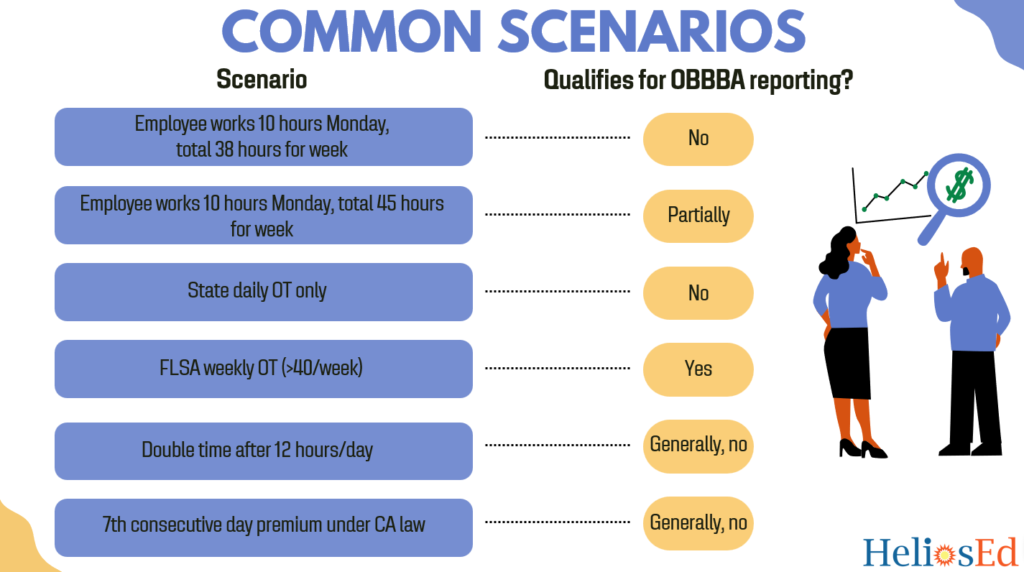
What Qualifies- and What Doesn’t?
One of the most common questions surrounding OBBBA is which overtime hours actually qualify for reporting.
Here are a few examples:
Frequently Asked Questions
- What if my pay period doesn’t match the workweek?
OBBBBA reporting follows FLSA rules, so overtime must always be calculated using the employee’s defined workweek, regardless of how the payroll period is structured.
- Does paid leave count toward the 40-hour threshold?
No. Under the FLSA, only actual hours worked count toward determining weekly overtime eligibility. Paid leave such as vacation, sick leave, or holidays does not contribute to the 40-hour threshold.
- What is the federal premium portion?
The federal premium is the additional half-time paid for hours worked beyond 40 in a workweek. Even if your district pays double time or additional premiums, only the FLSA-required half-time premium is considered qualified overtime for OBBBA reporting.
How Helios Simplifies OBBBA Reporting
Instead of relying on spreadsheets and manual calculations, Helios provides OBBBA-ready reports that help districts stay compliant with less effort.
By automatically incorporating work schedules, leave records, and extra duty hours, Helios enables payroll teams to calculate qualified overtime, and produce the reporting needed for compliance, all within a single system.
That means less manual work, greater accuracy, and more confidence during audits and year-end reporting.
Best Practices for OBBBA Compliance
As districts prepare for ongoing OBBBA reporting requirements, consider these best practices:
- Review your “hours worked” configurations to ensure they accurately reflect FLSA requirements.
- Separate state, union, and federal overtime earning codes so qualified overtime can be identified correctly.
- Coordinate across HR, payroll, finance, and legal teams to ensure policies and reporting practices remain aligned.
- Document your calculation methodologies so reporting is consistent, transparent, and audit-ready.
Final Thoughts
For school districts, success depends on understanding the difference between state and federal overtime rules, accurately identifying the FLSA overtime premium, and implementing reliable reporting processes.
With the right workflows, and the right tools, districts can meet OBBBA reporting requirements confidently while reducing manual effort and maintaining compliance.
0 Comments